Table tennis robots make it easier to practice consistently when a partner or coach is unavailable. The right machine can repeat serves, vary spin, target different areas of the table, and help you build dependable technique through focused drills.
We selected 10 table tennis robots with different combinations of controls, preset exercises, oscillation, ball capacity, recycling systems, and included accessories so you can match your budget and training goals.
Best 10 Table Tennis Robots Picks for 2026
Versatile Spin Practice

- Produces 36 spinning-ball combinations
- Supports topspin, backspin, and sidespin
- Holds approximately 110 balls
Best For: Players seeking portable, varied spin practice
Remote-Controlled Solo Training
Suz S102 Wireless Table Tennis Robot

- Wireless remote adjusts practice settings
- Supports direct and indirect serves
- Requires tables under 2.5 inches thick
Best For: Players practicing adjustable serves and spin
Fast Multi-Ball Practice

- Shoots up to 70 balls per minute
- Wireless control adjusts speed and spin
- Assembles without an app
Best For: Players wanting simple, high-frequency multiball practice
Smart Drill Programming
Triple-Motor Smart Table Tennis Robot
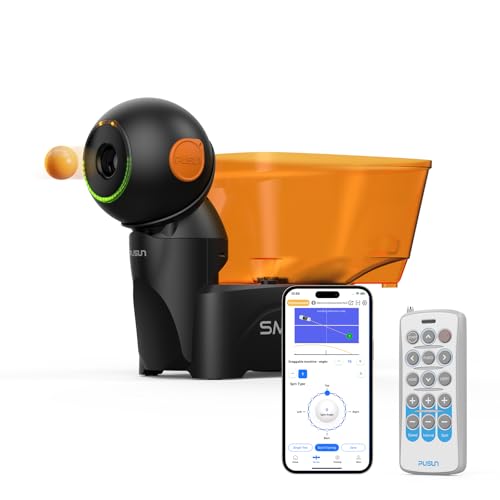
- Includes 200+ preset training drills
- Triple-motor system targets precise serving
- Controls spin, speed, frequency, and placement
Best For: Players seeking programmed, customizable training
Versatile Solo Trainer

- 35–90 balls per minute
- Nine spin modes and multiple serve patterns
- Includes wired remote and recycling net
Best For: Solo practice for beginners, advanced players, and coaches
Portable Pick
iPong Trainer Robot with 80 Balls
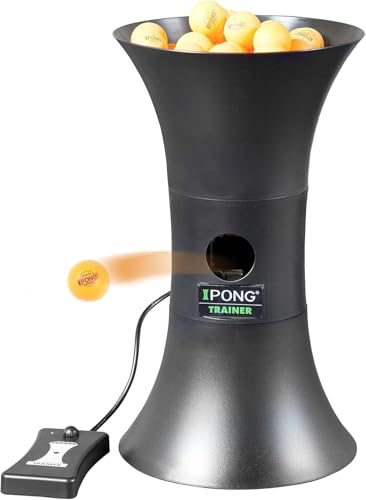
- Battery-operated with no outlet required
- Compact 2.6-pound design
- Includes 80 ABS training balls
Best For: Simple, portable practice for beginners and casual players
Programmable Drills
PONGBOT Robot with App Control

- 576 pre-saved trajectories
- Remote and app control
- Adjusts speed, rotation, frequency, landing, and height
Best For: Advanced, varied practice in a dedicated training setup
Feature-Rich Pick
PUSUN DORA Pro Table Tennis Robot

- Three serving motors for precise placement
- Preset and customizable full-court drills
- App, remote, voice, and recycling-net support
Best For: Players seeking varied, extended solo training
Accessible Training Pick

- 264 pre-saved drills
- Remote and smartphone app control
- Includes a ball recycling net
Best For: Beginners and developing solo players
Largest Drill Library

- 396 pre-saved ball trajectories
- E-Pad and app control
- Adjustable speed, spin, and trajectory
Best For: Players wanting detailed, customizable training
Versatile Spin Practice – 36-Spin Ping Pong Robot
This compact option is one of the more flexible table tennis robots for practicing varied spin. It can produce topspin, backspin, sidespin, and combinations of these, while its adjustable position lets you tailor the setup to your training preferences.
Best For: Players who want varied spin practice in a portable, straightforward machine.
Pros:
- Offers 36 spinning-ball combinations.
- Supports topspin, backspin, sidespin, and mixed spin.
- Holds approximately 110 balls in its container.
- Includes a one-year warranty for qualifying quality problems under normal use.
Cons:
- Requires more than 15 balls to serve properly.
- Uses 40mm international-standard balls, which are not included.
Its portable ABS construction and no-equipment installation make it practical for home practice, but buyers should plan to supply enough regulation-size balls before training.
Remote-Controlled Solo Training – Suz S102 Wireless Table Tennis Robot
The Suz S102 is a practical choice among table tennis robots for solo drills, with a wireless remote for adjusting training settings and a head that can be positioned for direct or indirect serves. Its guidance is particularly useful for buyers willing to follow the setup instructions carefully.
Best For: Players who want remote-controlled practice focused on adjustable serves, spin, and frequency.
Pros:
- Wireless remote control supports drill adjustments from across the table.
- Adjustable robot head allows direct or indirect serving.
- Designed to vary spin, speed, and ball frequency.
- Manufacturer provides free replacement parts for normal wear and tear within one year.
Cons:
- Only fits tables less than 2.5 inches thick.
- Requires at least 20 balls in the storage tube for proper serving.
- Oscillation and weak-serve issues may require troubleshooting during setup.
The S102 can help solve the need for a practice partner, but its table-thickness limit and setup-specific operating requirements are important compatibility checks.
Fast Multi-Ball Practice – iPong V300 Training Robot
The iPong V300 is a user-friendly pick among table tennis robots, combining wireless control with adjustable frequency, speed, direction, and spin. It assembles quickly and can shoot from 30 to 70 regulation-size balls per minute for sustained solo practice.
Best For: Beginners, families, and experienced players who want fast, adjustable multiball sessions.
Pros:
- Wireless remote works from the opposite side of the table.
- Adjusts ball frequency, speed, direction, topspin, and backspin.
- Shoots up to 70 balls per minute, with frequency adjustable down to 30.
- Offers fast assembly without an app or complicated instructions.
Cons:
- The supplied notes identify a one-year manufacturer warranty but do not specify included balls.
- Its 19-inch length may require more storage space than smaller designs.
With simple setup and broad remote-controlled adjustments, the V300 is a balanced choice for consistent repetition, especially when high ball frequency matters.
Smart Drill Programming – Triple-Motor Smart Table Tennis Robot
This advanced option stands out among table tennis robots with a triple-motor serve system, remote/app control, and more than 200 preset training drills. It is designed for broad table coverage and also lets players customize spin, speed, frequency, and serve placement.
Best For: Players who want structured, customizable training with app or remote control.
Pros:
- Includes more than 200 preset training drills.
- Triple-motor launching system is designed for stable, precise serving.
- Supports random serves, variable speed and frequency, and changing spin.
- Includes a remote, power adapter, manual, and warranty card.
Cons:
- Its listed dimensions are substantially larger than those of compact tabletop robots.
- The supplied notes list both a three-year after-sale warranty statement and a 1.5-year warranty description, so coverage should be confirmed before purchase.
The DORA Smart Pro is the most feature-rich choice here for programmed practice, though its larger listed size and warranty-detail discrepancy merit attention before ordering.
Versatile Solo Trainer – Adjustable Table Tennis Robot
This table tennis robot is designed for structured solo practice, with adjustable speed, frequency, spin, angle, and landing point. Its wired remote and included recycling net make it practical for players who want repeatable drills without constantly retrieving balls.
Best For: Beginners through advanced players, coaches, and anyone practicing serves, returns, and spin variations alone.
Pros:
- Offers 35–90 balls per minute and adjustable speed from 4–40 m/s.
- Includes nine spin modes plus fixed-point, swing, and random serving.
- Wired remote provides convenient control of key training settings.
- Recycling net helps collect balls during solo sessions.
Cons:
- At 12 pounds, it is less lightweight than compact travel-oriented trainers.
- Operation relies on a wired remote rather than app control.
With broad adjustment options and shortcut keys for common drills, this model suits players who want a flexible table tennis robot for progressive training. The included net adds convenience for repeated practice.
Portable Pick – iPong Trainer Robot with 80 Balls
The iPong Trainer is a compact table tennis robot for straightforward solo practice. Its battery-powered design, wired speed control, quick assembly, and included 80 ABS balls make it convenient for beginners and players who want an easy-to-store setup.
Best For: Beginners, casual players, and users who prioritize portability and simple operation.
Pros:
- Battery-operated and wireless, so it can be placed where convenient without an outlet.
- Wired remote allows speed adjustment for different skill levels.
- Compact 19-by-11-inch footprint and 2.6-pound weight support easy storage and transport.
- Includes 80 quality-checked 40mm ABS training balls.
Cons:
- The supplied notes specify speed adjustment but do not list spin or trajectory controls.
- Its plastic construction may be less substantial than heavier metal-framed machines.
This is a practical entry-level option among table tennis robots, especially if quick setup and portability matter more than advanced programming. The included balls help get training started immediately.
Programmable Drills – PONGBOT Robot with App Control
The PONGBOT is an advanced table tennis robot built around programmable practice. Remote and app control, 576 pre-saved trajectories, automatic oscillation, and adjustable drill settings give players extensive options for varying ball placement and training patterns.
Best For: Adult players seeking programmable drills and a wide range of automated practice routines.
Pros:
- Provides 576 pre-saved trajectories for varied training sessions.
- Supports remote and app control.
- Allows programming of frequency, ball speed, rotation, landing, and height.
- Automatic oscillation helps vary ball placement across the table.
Cons:
- At 14 kg, it is substantially heavier than compact table tennis robots.
- The advanced control and programming features may be more than casual users need.
- The supplied details do not specify included balls or a warranty.
For players who want highly varied and repeatable practice, this model stands out for its large trajectory library and programmable settings. Its heavier build makes it better suited to a dedicated training location than frequent transport.
Feature-Rich Pick – PUSUN DORA Pro Table Tennis Robot
Among table tennis robots, the PUSUN DORA Pro stands out for combining three serving motors, voice and light controls, preset drills, and a ball recycling net. It supports real-time speed, frequency, spin, and landing-point adjustments through its app or remote, making it adaptable for structured solo practice.
Best For: Players who want varied, app-controlled training with reduced ball-collection downtime.
Pros:
- Three serving motors are designed for stable, precise landing points.
- Includes preset drills and visually customizable, full-court routines.
- Ball recycling net supports longer practice sessions without frequent pickup.
- Offers app and remote control with real-time adjustments.
Cons:
- Only one device can be connected at a time.
- Its listed dimensions are relatively large for a table tennis robot.
- Warranty information differs between the notes and product details.
The DORA Pro is a versatile training partner for beginners through advanced players, especially if drill variety and continuous practice matter more than compact storage.
Accessible Training Pick – PONGBOT NOVA S Pro
The PONGBOT NOVA S Pro is one of the more approachable table tennis robots for players who want guided practice without complicated setup. It includes a recycling net, remote and smartphone app control, 264 pre-saved drills, and the option to build custom routines.
Best For: Beginners and developing players who want broad drill selection and flexible controls.
Pros:
- Includes 264 pre-saved drills for varied practice.
- Supports both remote and smartphone app control.
- Custom drills allow users to tailor training sessions.
- Ball recycling net simplifies setup and ball collection.
Cons:
- One-year warranty is shorter than the warranty stated for some competing models in this roundup.
- Plastic construction may be less substantial than models with metal components.
- Practice is designed for one player at a time.
With its large drill library and straightforward control options, the NOVA S Pro is a practical choice for solo learners who want an affordable, repeatable training routine.
Largest Drill Library – PONGBOT OMNI S Pro
The PONGBOT OMNI S Pro is a strong option among table tennis robots for players who want extensive programming flexibility. Its 396 pre-saved ball trajectories, E-Pad and app controls, and adjustable speed, spin, frequency, trajectory, and landing settings support detailed solo training.
Best For: Players who want the broadest built-in drill library and highly customizable routines.
Pros:
- Provides 396 pre-saved ball trajectories across multiple drill options.
- Adjusts speed, spin, frequency, trajectory, and landing point.
- Includes both an E-Pad remote and Pongbot app control.
- App library supports shared and customized visual routines.
Cons:
- 40mm and 40mm+ balls are not included.
- At 19.8 pounds, it may be less convenient to move than lighter options.
- One-year warranty is specified.
The OMNI S Pro is best suited to committed players who will use its extensive trajectory library and programming controls, while buyers should budget separately for compatible balls.
How We Picked the Best Table Tennis Robots
We compared these Table Tennis Robots by the features that have the greatest effect on practice quality and day-to-day convenience. Our evaluation focused on spin and speed adjustment, placement control, oscillation, remote or app operation, preset and programmable drills, ball collection, included nets or balls, and the practicality of setup and storage.
Because product specifications can vary by seller and configuration, check the current listing for exact ball compatibility, capacity, control method, and included accessories before ordering. A robot with more drills is not automatically better if its controls are difficult to use or its placement range does not suit your table.
Quick Comparison
| Feature | Why It Matters | Best For |
|---|---|---|
| Preset drills | Provides structured repetition without extensive setup | Beginners and routine practice |
| Programmable trajectories | Allows customized placement, timing, and sequences | Advanced players and coaches |
| Oscillation | Moves the ball across different areas of the table | Footwork and lateral movement |
| Remote or app control | Makes adjustments easier during practice | Convenient solo sessions |
| Ball recycling | Reduces interruptions for collecting balls | High-volume training |
| Included net and balls | May simplify setup and improve initial value | First-time buyers |
Key Buying Factors for Table Tennis Robots
Spin, Speed, and Placement Control
Look for independent adjustment of speed, frequency, launch angle, and spin direction. Placement control is especially important: a machine that can vary width and depth is more useful for practicing footwork, returns, and transitions than one that repeatedly feeds the same spot.
Drill Selection and Customization
Preset drills are convenient for beginners, while programmable sequences are valuable for players working on specific weaknesses. Consider whether the robot stores drills, supports custom patterns, or offers app-based control. A large drill count is useful only when the interface makes those options easy to find.
Ball Handling and Setup
Check whether the unit includes a collection net, recycling system, or compatible training balls. Recycling reduces downtime, but the machine still needs correct placement and regular clearing of jams. Also measure your table and storage area before choosing a larger system.
Controls and Reliability
Remote controls are straightforward, while app controls may provide more detailed programming. Choose the system you are most likely to use consistently. Confirm the return policy, replacement-part availability, and current warranty information, particularly for motorized models.
Who Should Buy Which Table Tennis Robots?
- Beginners: Choose a straightforward robot with preset drills, simple speed and spin controls, and included balls or a net.
- Intermediate players: Prioritize oscillation, adjustable placement, multiple spin types, and remote or app control for varied sessions.
- Advanced players and coaches: Look for programmable trajectories, extensive drill libraries, triple-motor or independently adjustable systems, and repeatable settings.
- High-volume trainers: A ball recycling facility, large capacity, and reliable automatic feeding can matter more than the maximum number of presets.
- Limited-space users: Favor compact designs with quick setup and confirm that the net or collection system fits your table and room.
The best choice is the robot that matches your practice style and table setup. Start with the controls and training features you will use regularly, then weigh convenience, included accessories, and long-term support.