Adjustable table tennis robots make solo practice more structured by repeating serves, spins, placements, and speeds on demand. The right machine can help beginners build consistency while giving experienced players a practical way to target weaknesses.
We selected 10 options with different control systems, preset drills, oscillation features, ball-handling designs, and portability. Use the guide below to match your training goals and table setup with the most suitable robot.
Best 10 Adjustable Table Tennis Robots Picks for 2026
Most Customizable
PONGBOT Adjustable Table Tennis Robot

- 576 pre-saved trajectories
- Remote and app control
- Adjustable speed, spin, placement, and height
Best For: Players seeking highly customizable solo drills
Budget-Friendly Trainer
Suz S102 Wireless Table Tennis Robot

- Wireless remote controls practice settings
- Adjustable head for direct or indirect serves
- Requires tables under 2.5 inches thick
Best For: Players wanting basic remote-controlled solo practice
Best for Extended Sessions

- Includes ball-recycling net
- App and remote real-time control
- Three-motor serving system
Best For: Players who want convenient, uninterrupted training
Best Drill Variety
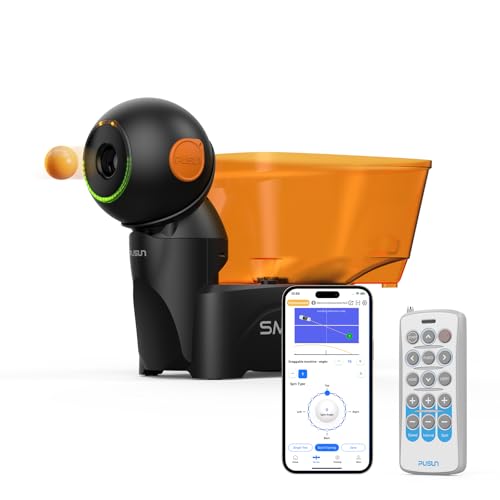
- More than 200 preset drills
- Triple-motor serving system
- Remote and app customization
Best For: Players building varied and personalized practice routines
Best Adjustable Starter Robot
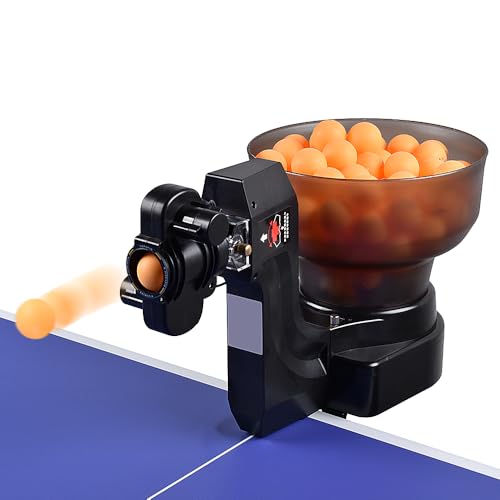
- Nine spin modes with adjustable speed and pitch
- 120-ball hopper with automatic oscillation
- Tool-free clamp and two-year warranty
Best For: Beginners and intermediate home players
Best Connected Training Robot

- Bluetooth app control with supplied Android tablet
- Programmable and randomized drill sequences
- Includes recycling net, carry bag, and three-year warranty
Best For: Serious players building structured practice routines
Best Complete Recycling System

- 200-ball automatic recycling net
- Nine spin modes and 8.9–76 mph speed range
- Ambidextrous detachable control panel
Best For: Extended solo practice with minimal ball pickup
Best Wireless-Controlled Pick

- Remote adjusts speed, frequency, direction, and spin
- Serves 30 to 70 balls per minute
- Quick setup without an app
Best For: Simple solo practice for beginners, kids, and adults
Best Drill-Programming Option

- Includes 264 pre-saved drills
- Supports custom drills and app control
- Comes with a ball-recycling net
Best For: Structured, customizable practice across skill levels
Best Spin Variety on a Budget

- Offers 36 spinning-ball combinations
- Supports topspin, backspin, and sidespin
- Compact and holds about 110 balls
Best For: Spin-focused practice with a compact machine
Most Customizable – PONGBOT Adjustable Table Tennis Robot
For players comparing adjustable table tennis robots, the PONGBOT stands out for its extensive drill customization. Remote or app control lets you adjust frequency, ball speed, rotation, landing point, and height, while 576 pre-saved trajectories provide plenty of practice variety.
Best For: Adult players who want broad control over solo training sessions and programmable drills.
Pros:
- Includes 576 pre-saved trajectories.
- Supports remote and app control.
- Adjusts frequency, speed, rotation, landing point, and height.
- Automatic oscillation helps vary ball placement.
Cons:
- Listed weight is 14 kg, so it may be less convenient to move.
- The supplied details do not specify a warranty or included ball-recycling net.
This is a feature-rich choice for users who prioritize drill variety and fine-grained adjustments over a simpler setup.
Budget-Friendly Trainer – Suz S102 Wireless Table Tennis Robot
The Suz S102 is a practical option among adjustable table tennis robots for players who want remote-controlled solo practice. You can adjust spin, speed, frequency, oscillation, and the robot head angle, with settings for direct or indirect serves.
Best For: Players who want a straightforward wireless trainer and already have a compatible table.
Pros:
- Wireless remote control adjusts key serving settings.
- Robot head can be adjusted up and down.
- Supports direct and indirect serve practice.
- Manufacturer states that free replacement parts are provided for normal wear and tear within one year.
Cons:
- Only fits table tennis tables less than 2.5 inches thick.
- Proper operation requires at least 20 balls in the storage tube.
- Setup and oscillation may require following specific manual or support instructions.
Its table-thickness restriction is important to check before buying, but compatible users get useful basic controls for solo drills and serve practice.
Best for Extended Sessions – PUSUN DORA Pro Robot
The PUSUN DORA Pro combines adjustable table tennis robot controls with a ball-recycling net, helping reduce interruptions during practice. Its app and remote support real-time changes to speed, frequency, spin, and landing point, while preset drills and voice controls add convenience.
Best For: Beginners through advanced players who want longer practice sessions with app control and automatic ball collection.
Pros:
- Includes a ball-recycling net for extended practice.
- Offers app and remote control, with real-time adjustments.
- Three serving motors are designed for stable, precise landing points.
- Includes preset drills and full-court landing-point customization.
Cons:
- Only one device can be connected at a time.
- The supplied notes list both a 3-year service statement and a 1-year warranty description, so coverage should be verified.
The recycling net and broad adjustment range make this a compelling convenience-focused option, especially for users who do not want to pause frequently to collect balls.
Best Drill Variety – DORA Smart Pro Robot
The DORA Smart Pro is one of the more versatile adjustable table tennis robots for structured practice. It provides more than 200 pre-saved drills, triple-motor serving, full-table landing coverage, and remote or app adjustment of spin, speed, frequency, and serve combinations.
Best For: Players at any stated age level who want varied preset drills plus the ability to build personalized routines.
Pros:
- Includes more than 200 pre-saved training drills.
- Triple-motor launching system supports precise, stable serving.
- Offers full-court landing-point coverage.
- Allows customized spin, speed, frequency, and serve combinations.
Cons:
- The supplied dimensions are 65 inches long by 13 inches wide by 25.6 inches high, so storage space should be considered.
- The notes list a 3-year service statement and a 1.5-year warranty description; confirm the applicable coverage.
With extensive preset content and customizable serves, this model suits players who want a structured training library without giving up control over individual drills.
Best Adjustable Starter Robot – Portable HP-07
For shoppers comparing adjustable table tennis robots, the WAYMARK HP-07 is a portable option with dual motors, nine spin modes, adjustable speed, and automatic oscillation. Its 120-ball hopper supports extended solo sessions, while the clamp-on mount fits tables up to 2.5 inches thick.
Best For: Beginners and intermediate players seeking customizable solo practice in a compact, portable setup.
Pros:
- Nine spin modes, including topspin, backspin, sidespin, and no-spin.
- Adjustable serving speed from 8.9 to 76 mph and adjustable pitch angles.
- 120-ball hopper and automatic oscillation support varied landing points.
- Includes a two-year warranty and tool-free table clamp.
Cons:
- Ball catch net is sold separately.
- Plastic construction may feel less substantial than heavier professional units.
The HP-07 offers a useful range of adjustments without requiring a complex installation. It is a practical choice for home users who want varied drills and easy storage.
Best Connected Training Robot – Butterfly Amicus Prime
The Butterfly Amicus Prime is a feature-rich choice among adjustable table tennis robots, offering wireless control through its supplied Android tablet and app. Players can adjust frequency from 5 to 120 balls per minute, combine drills into sequences, and use the included recycling net for more efficient practice.
Best For: Serious players who want app-controlled drills, programmable sequences, and a complete practice package.
Pros:
- Wireless Bluetooth control through the Amicus app and Android tablet.
- Ball frequency adjusts from 5 to 120 balls per minute.
- Supports saved drills, automatic sequences, and random drill order.
- Includes 120 balls, recycling net, carry bag, and a three-year warranty.
Cons:
- At 20 pounds, it is heavier than the portable WAYMARK options.
- Its advanced app-based controls may be more than casual players need.
The Amicus Prime stands out for structured training rather than simple ball launching. Its programmable approach suits players who want repeatable routines and ongoing software updates.
Best Complete Recycling System – WAYMARK JT-A Robot With Net
The WAYMARK JT-A is one of the more complete adjustable table tennis robots for solo practice because it combines customizable speed and spin settings with an automatic recycling net. The system holds up to 200 balls, offers nine spin modes, and includes a detachable control panel that can be positioned on either side.
Best For: Players who want long, interruption-free training sessions and flexible control placement.
Pros:
- Automatic recycling net holds up to 200 balls.
- Adjustable speed from 8.9 to 76 mph with customizable angles and frequencies.
- Nine spin modes support topspin, backspin, sidespin, mixed-spin, and no-spin drills.
- Ambidextrous detachable control panel and included 100 balls.
Cons:
- The recycling setup is much larger than a standalone robot.
- It fits tables up to 2.5 inches thick, so table compatibility should be checked.
With its integrated net and high capacity, the JT-A is designed to minimize interruptions during practice. It is especially appealing when efficient, extended solo sessions matter more than compact storage.
Best Wireless-Controlled Pick – iPong V300
The iPong V300 is a practical choice for shoppers comparing adjustable table tennis robots for solo practice. Its wireless remote lets you adjust frequency, speed, direction, and spin while standing at the opposite end of the table.
Best For: Beginners, kids, adults, and players who want straightforward controls without an app.
Pros:
- Wireless remote includes memory buttons for on-the-fly adjustments.
- Adjustable ball frequency, speed, direction, topspin, and backspin.
- Serves between 30 and 70 balls per minute.
- Fast setup with no app download or complicated instructions.
Cons:
- Requires a table and 40mm regulation balls for practice.
- Its playback mode is not included, according to the product title.
With simple controls, quick assembly, and a one-year manufacturer warranty, the V300 is a convenient training robot for users who value ease of operation over app-based drill programming.
Best Drill-Programming Option – PONGBOT NOVA S Pro
For shoppers seeking adjustable table tennis robots with structured training options, this PONGBOT model stands out for its 264 pre-saved drills and custom-drill capability. It also includes a recycling net to simplify setup and practice.
Best For: Players of different skill levels who want app or remote control and a broad selection of programmed exercises.
Pros:
- Includes 264 pre-saved drills for varied training.
- Supports custom drills for more personalized practice.
- Can be controlled with either the included remote or a smartphone app.
- Includes a ball-recycling net and power adapter.
Cons:
- Its app-based features may be more involved than basic remote-only machines.
- The listed dimensions and 4kg weight may require more setup space than compact options.
The NOVA S Pro is the strongest fit here for players who want guided variety and customization rather than only basic ball feeding. Its one-year warranty adds useful purchase support.
Best Spin Variety on a Budget – 36-Spin Ping Pong Robot
This automatic ball machine is a useful option for comparing adjustable table tennis robots focused on spin practice. It offers 36 spinning-ball combinations, including topspin, backspin, sidespin, and combinations of these effects.
Best For: Players who want compact equipment for experimenting with multiple spin types and serve trajectories.
Pros:
- Provides 36 different spinning-ball settings.
- Supports topspin, backspin, sidespin, and combined spin.
- Compact design measures 12 by 10 by 11 inches.
- Ball container holds approximately 110 balls.
Cons:
- Requires more than 15 balls to operate and does not include balls.
- Must be used with international-standard 40mm balls.
- Landing points are not fixed, which may limit repeatable placement drills.
Its main appeal is spin variety in a relatively compact package. Buyers should budget for compatible balls and keep at least 15 loaded for reliable operation; a one-year warranty is included for normal-use quality issues.
How We Picked the Best Adjustable Table Tennis Robots
We compared these machines by the training adjustments they offer, including speed, frequency, placement, spin, trajectory, and oscillation. We also considered how easily players can change settings through a remote, smartphone app, onboard controls, or voice commands.
Practical ownership features mattered too. Ball recycling, included nets, regulation-ball compatibility, carrying cases, preset drills, custom programming, and overall portability can make a significant difference when a robot is used regularly. Because product configurations may vary, confirm the current specifications and included accessories before ordering.
Quick Comparison
| Feature | Why It Matters | Best For |
|---|---|---|
| Preset drills | Provides ready-to-use practice patterns | Beginners and structured sessions |
| Custom programming | Lets you target specific weaknesses | Intermediate and advanced players |
| Remote or app control | Allows adjustments without leaving the table | Convenient solo practice |
| Oscillation | Moves the ball across different placements | Footwork and consistency training |
| Ball recycling | Reduces interruptions for collection | High-volume sessions |
| Portable design | Makes storage and transport easier | Shared spaces and clubs |
Key Buying Factors for Adjustable Table Tennis Robots
Spin, Speed, and Placement Control
Look for independent adjustments rather than a single preset speed. Topspin, backspin, sidespin, feed frequency, launch angle, and left-to-right oscillation determine how closely the robot can replicate match situations. Beginners may prefer simple controls, while advanced players benefit from precise settings and custom sequences.
Drills and Programming
Preset drills are useful for quick sessions, but a large drill library is not automatically better. Check whether the robot supports random placement, alternating locations, multiball patterns, and user-created routines. These features are especially valuable when training serves, returns, transitions, or movement.
Control Method and Setup
A remote is convenient for basic changes, while an app may offer more detailed programming and saved routines. Confirm wireless range, app compatibility, and whether the machine requires a separate net or mounting arrangement. A built-in net and ball collection system can simplify setup considerably.
Ball Compatibility and Capacity
Verify the recommended ball size and material before buying. Regulation 40mm balls are generally the safest choice for consistent training, but some machines work best with specific ball types. A larger hopper and reliable recycling system mean fewer pauses during practice.
Portability and Durability
Consider the robot’s weight, carry handle, storage footprint, and included bag if you will move it often. For permanent home setups, prioritize stable placement, easy cleaning, and accessible replacement parts over the lightest design.
Who Should Buy Which Adjustable Table Tennis Robots?
Beginners should prioritize straightforward controls, preset drills, adjustable speed, and dependable ball feeding. Players developing footwork should look for oscillation and varied placement. Intermediate and advanced users will get more value from programmable trajectories, multiple spin settings, detailed app control, and custom drills.
Choose a compact portable model for occasional practice or shared rooms. Choose a robot with a net and recycling system for longer, uninterrupted sessions. If several players will use the machine, favor broad adjustment ranges and easy-to-understand controls so everyone can create an appropriate workout.